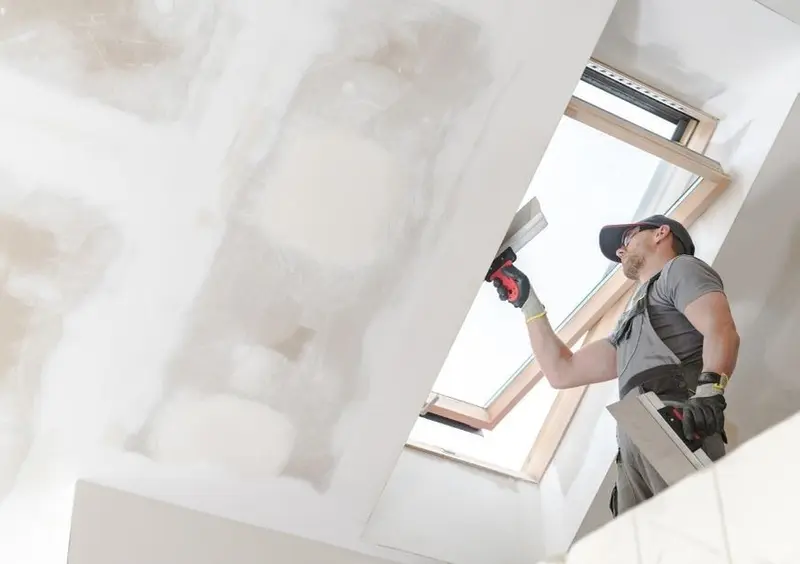
Water-stained or sagging ceilings: safety and the leak first
A ceiling that bulges, sags or drips may be holding water or pulling off its fixings. Don't stand or sleep under it, move furniture out of the way, keep children and pets out, and don't push on the board: wet gypsum ceiling boards are heavy and can come down without warning. Light fittings near the damp should not be used until an electrician has checked them.
Replacing a stained board without stopping the water means doing it again after the next storm. The roof, gutters, flashing or plumbing above should be repaired first, and the roof space allowed to dry, since damp timber and wet insulation keep staining new boards. A burst pipe or leaking geyser in the roof needs a qualified plumber; mention it in your enquiry so the ceiling work can be planned for afterwards.
Ceiling repairs: replacing gypsum ceiling boards
Light stains on boards that are dry and firm may only need a stain-blocking primer and paint. Boards that are soft, sagging or crumbling are cut out and replaced, with the new boards screwed to the brandering and the joints taped and skimmed. If water has damaged the brandering, or the old boards had too few fixings, that should be corrected too, or the new boards may sag in the same place.
Matching an old texture or board thickness can be tricky in older homes. Replacing a whole bay or room sometimes gives a more even result than patching. Most repairs need access to the roof space through a trapdoor, and insulation that was moved or soaked should be dried or replaced and laid back evenly.
Cracked joints and cornices
Straight cracks along board joints are common, caused by roof timbers moving with temperature and moisture, or by joints that were filled but never taped. Re-taping and skimming the joint usually lasts longer than filling the crack alone.
Cornices crack or pull away where the ceiling and walls move differently, and can be re-fixed or replaced with a flexible joint. Cracks that keep growing or run diagonally across the ceiling may point to a problem in the roof structure and need a closer look before any cosmetic repair.
- Screw pops showing as small bumps
- Lifting or cracked joint tape
- Gaps between cornice and wall
- Diagonal cracks across the ceiling
Ceiling installation and bulkheads
Ceiling installation in Pretoria is often part of a renovation: replacing an old ceiling, closing in an open patio roof, or adding a ceiling to an outbuilding. Bulkheads around kitchens, showers and downlights are framed in timber or light steel and clad in board, so they can be built, reshaped or repaired like a ceiling.
Any wiring or downlights in a new ceiling or bulkhead must be done by a registered electrician, who issues a Certificate of Compliance. The usual order is framing first, then the electrician's first fix, then boarding and finishing. Say in your enquiry if electrical work is planned so the contractor can explain how the trades fit together.
Drywall holes, cracks and water damage
Drywall is gypsum board on a light steel or timber frame, so it dents and punctures more easily than brick and plaster. Door handles without stoppers, furniture moves and removed TV brackets are the usual causes of holes. Small and medium holes are patched by cutting a neat square, fitting a backing piece and finishing over it. Cracked joints come from lifting tape or shrunken compound, often next to a door that slams.
Board that got wet from a leak and dried hard can sometimes be sealed and painted, but swollen or mouldy sections are cut out and replaced once the source of the water has been fixed. Cut-outs left by moved plug points or data points can be made good after the electrician has finished.
Drywall partitioning for homes and offices in Pretoria
Drywall partitions are a tidy way to split an office into meeting rooms, create a home study, or close off part of an open-plan area. They are non-load-bearing: the frame is fixed to the floor and ceiling and carries neither roof nor upper floor. Insulation in the frame and sealed edges cut down noise, although a partition won't block sound like a brick wall, so mention it if privacy matters.
Removing a partition is simpler than removing masonry, but the floor, ceiling and adjoining walls need patching where the frame was fixed. If you are unsure whether a wall is drywall or brick, or whether it carries load, the contractor can check before quoting. Office partitions in a shared building may need the landlord's or body corporate's approval, and the contractor can advise whether plans may be needed; check with the City of Tshwane if unsure.
Finishing, painting and moisture-resistant boards
A repair is only as good as its finish. Jointing compound goes on in thin coats, feathered out wide and sanded smooth, and walls or ceilings that catch strong side light may need a full skim so the repair disappears. Patches that show through paint, called flashing, happen because filler absorbs paint differently; a suitable primer first, then painting the whole wall or ceiling, gives an even result, especially since old ceiling paint yellows.
Standard board is not suited to bathrooms, laundries or kitchens. Moisture-resistant boards, usually with green or blue face paper, handle steam better, but they are not waterproof: areas inside a shower still need a proper waterproofing system before tiling, and good ventilation prevents the mould and peeling that return over showers and stoves.
Ceilings & Drywall: common questions
Can a stained ceiling just be painted over?
Ordinary paint lets water stains bleed through. A stain-blocking primer is needed first, and only once the board is dry and firm and the leak has stopped.
Will my homeowner's insurance cover a damaged ceiling?
That depends on your policy and the cause, so check with your insurer before work starts. Take photos, keep damaged material until they say otherwise, and ask the contractor for an itemised quote.
Why do ceiling cracks keep coming back?
Repeat cracks along the same line suggest ongoing movement in the roof timbers, or joints that were filled rather than taped. Dealing with the cause and taping the joint gives a longer-lasting result.
Will a drywall patch match the rest of the wall?
On smooth walls, careful sanding and a skim usually blend it in well. Textured or older finishes are harder to match, so daylight photos help the contractor judge how much of the wall may need attention.
How messy is ceiling or drywall work?
Cutting out boards releases dust and sometimes insulation into the room. Expect floors and furniture to be covered, but clearing the room as much as you can beforehand helps.
Should I paint the repair myself or leave it to the contractor?
Either works, so say which you prefer when you enquire. If you paint it yourself, let the compound dry fully and prime it first, otherwise the patch is likely to show.
Areas
Enquiries for ceilings & drywall are referred across Pretoria East and Centurion, including:
Related services
Home & Property Maintenance
Seasonal upkeep, plaster cracks, sticking doors, sliding doors and window frames, plus rental turnarounds and complex maintenance.

Roof Repairs & Waterproofing
Roof leaks traced and repaired on tiled, IBR and flat concrete roofs, plus torch-on waterproofing, gutters, fascias and damp walls.

Painting
Interior and exterior painting with proper preparation, crack repair and the right finish for each room and wall.